Buy roditeli.eu ?
We are moving the project
roditeli.eu .
Are you interested in purchasing the domain
roditeli.eu ?
domain@kv-gmbh.de · 0541-91531010
Buy roditeli.eu ?
What is the transition from chemistry to food chemistry?
The transition from chemistry to food chemistry involves applying the principles and concepts of chemistry to the study of food and its components. This includes understanding the chemical composition of food, the reactions that occur during cooking and processing, and the impact of different chemical compounds on flavor, texture, and nutritional value. Food chemists also focus on food safety, preservation, and the development of new food products using their knowledge of chemistry. Overall, the transition involves a shift in focus from general chemistry to the specific application of chemistry in the context of food. **
Is a chemistry education without a solid understanding of chemistry worthwhile?
A chemistry education without a solid understanding of chemistry is not as valuable as one with a strong foundation in the subject. Without a solid understanding of chemistry, students may struggle to grasp more complex concepts and may not be able to apply their knowledge effectively in real-world situations. A solid understanding of chemistry is essential for success in fields such as medicine, environmental science, and materials science, so it is important for students to prioritize building a strong foundation in the subject. **


Similar search terms for Chemistry
Top-Angebote
Products related to Chemistry:
-
Inspired Finds 3x3x3 Educational Magic Puzzle Cube STEM Math & Chemistry Learning Toy For Kids With Display Base chemistryTurn playtime into a fun learning adventure with the Educational Magic Puzzle Cube. This innovative 3x3x3 puzzle cube combines the excitement of problemsolving with the fundamentals of math, chemistry, and physics, making it both entertaining and...34,99 $*Shipping: 0,00 $Secure redirect to the provider
-
My Revision Notes: AQA GCSE (9-1) Biology, Physics & Chemistry 3 Books Collection Set - Ages 14-16 - Paperback Hodder EducationTitle in This Set: 1. My Revision Notes: AQA GCSE (9-1) Biology 2. My Revision Notes: AQA GCSE (9-1) Physics 3. My Revision Notes: AQA GCSE (9-1) Chemistry Description: Exam Board: AQA Level: GCSE Subject: Biology, Physics & Chemistry First Teaching: September 2016 First Exam: Summer 2018 Unlock your students' full potential with these revision guides from our best-selling series My Revision Notes With My Revision Notes your students can: - Manage their own revision with step-by-step support from experienced teachers with examining experience. - Apply scientific terms accurately with the help of definitions and key words. - Prepare for practicals with questions based on practical work. - Focus on the key points from each topic - Plan and pace their revision with the revision planner. - Test understanding with end-of-topic questions and answers. - Get exam ready with last minute quick quizzes available on the Hodder Education Website.19,99 £*Shipping: 2,99 £Secure redirect to the provider
-
Kiss Bare But Better Medium false nails Chemistry 28 pcKISS Bare But Better Medium, 28 pc, Gel and Acrylic Nails for Women, Are you a fan of precise yet easy manicures? Then you'll love the ease of application of KISS Bare But Better Medium false nails. They allow you to create a beautiful manicure like a professional very quickly and in the comfort of your home. They will give your hands a sophisticated look that will be suitable for many different occasions. In addition, the manicure will last in perfect condition longer than one created with the help of conventional nail polish. Just glue on the nails according to size and you're done: a salon-like manicure! Characteristics: the set contains special nail glue for an instant salon-like gel manicure effect thanks to its excellent adhesion, it lasts on nails for a very long time designed for repeated use How to use: Apply a drop of glue to the artificial nails, put them on your actual nails and press them for at least 30 seconds. Press or carefully remove the cuticle with manicure scissors or clippers.6,97 £*Shipping: 3,99 £Secure redirect to the provider
-
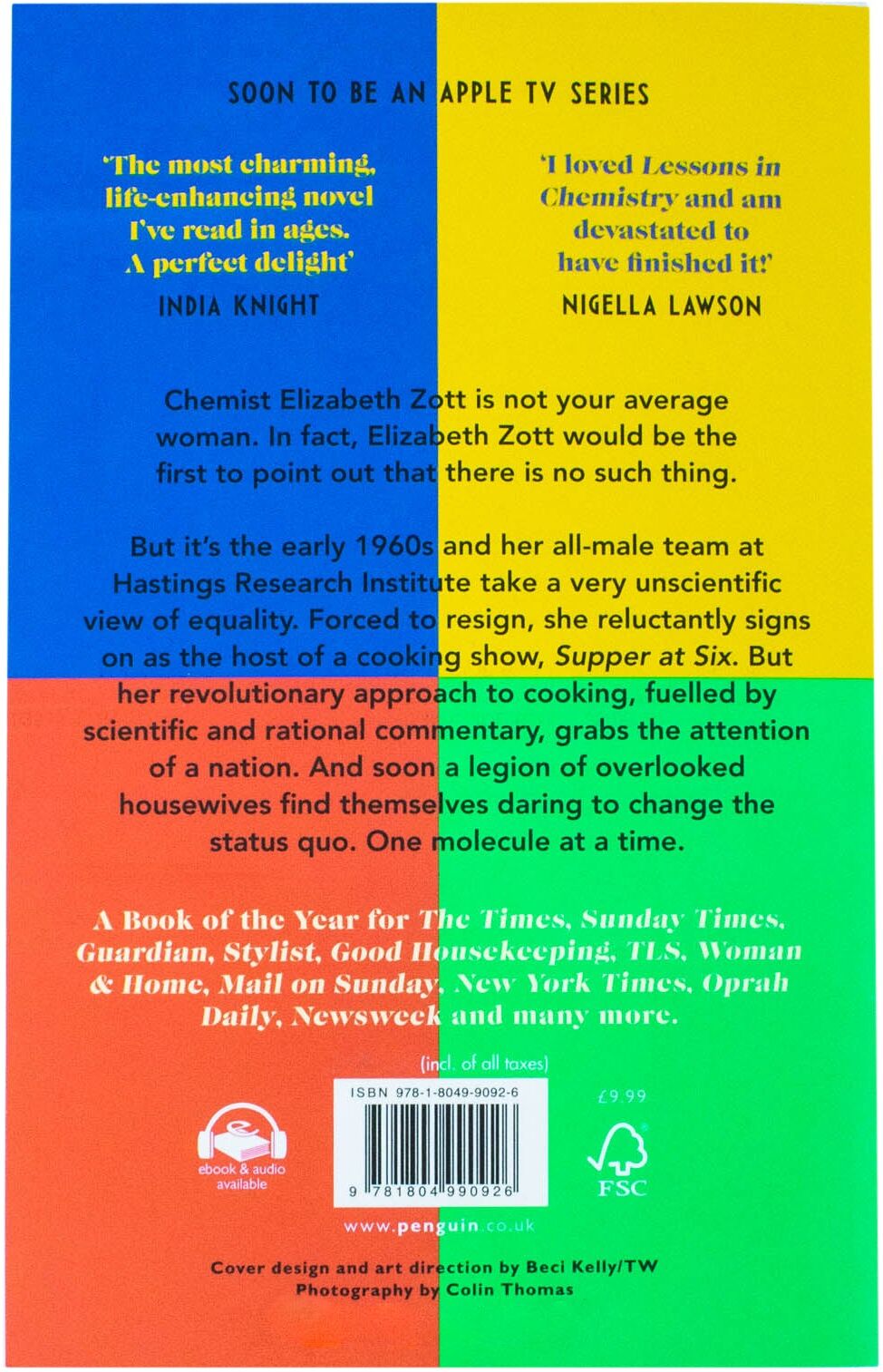
Penguin Lessons in Chemistry: The multi-million copy bestseller by Bonnie GarmusYour ability to change everything - including yourself - starts hereChemist Elizabeth Zott is not your average woman. In fact, Elizabeth Zott would be the first to point out that there is no such thing.But it's the early 1960s and her all-male team at Hastings Research Institute take a very unscientific view of equality. Forced to resign, she reluctantly signs on as the host of a cooking show, Supper at Six. But her revolutionary approach to cooking, fuelled by scientific and rational commentary, grabs the attention of a nation.Soon, a legion of overlooked housewives find themselves daring to change the status quo. One molecule at a time.5,99 £*Shipping: 2,99 £Secure redirect to the provider


-
Is a chemistry education without a reasonably solid knowledge of chemistry meaningful?
No, a chemistry education without a reasonably solid knowledge of chemistry is not meaningful. A strong foundation in chemistry is essential for understanding the principles, theories, and applications of the subject. Without a solid knowledge base, students would struggle to grasp complex concepts, make connections between different topics, and apply their learning to real-world scenarios. Therefore, a thorough understanding of chemistry is crucial for a meaningful chemistry education. **
-
What is the chemistry behind fast food?
Fast food typically contains high levels of fat, sugar, and salt, which are all highly palatable and can lead to overeating. The high fat content in fast food can lead to the release of dopamine in the brain, which can create a feeling of pleasure and satisfaction. Additionally, the high sugar content in many fast food items can lead to a rapid spike in blood sugar levels, followed by a crash, which can lead to cravings for more sugary foods. The combination of these factors can contribute to the addictive nature of fast food. **
-
What career prospects are there for a chemistry degree?
A chemistry degree opens up a wide range of career prospects in various industries such as pharmaceuticals, biotechnology, environmental science, materials science, and forensics. Graduates can pursue roles as chemists, research scientists, laboratory technicians, quality control analysts, and chemical engineers. Additionally, a chemistry degree can also lead to opportunities in academia, teaching, and scientific writing. The analytical and problem-solving skills gained through a chemistry degree are highly valued in many sectors, making it a versatile qualification with diverse career options. **
-
What is the order: Education before studying chemistry?
The order is to first pursue a formal education, which typically involves completing high school and obtaining a bachelor's degree in a related field such as chemistry or a related science. After completing the necessary educational requirements, one can then focus on studying chemistry in more depth through advanced coursework, research, and practical laboratory experience. This sequential approach ensures a strong foundation in general education before delving into the specialized study of chemistry. **


How do you calculate dilutions in food chemistry and in the study of analytical chemistry?
In food chemistry, dilutions are calculated by using the formula C1V1 = C2V2, where C1 is the initial concentration of the solution, V1 is the initial volume of the solution, C2 is the final concentration of the solution, and V2 is the final volume of the solution. This formula is used to determine the amount of a concentrated solution needed to make a desired volume of a more dilute solution. In the study of analytical chemistry, dilutions are also calculated using the same formula. However, in analytical chemistry, dilutions are often used to prepare standard solutions for calibration of instruments or for creating known concentrations of a substance for analysis. The accuracy and precision of dilutions are crucial in analytical chemistry to ensure the reliability of experimental results. **
What is sustainability in education?
Sustainability in education refers to the integration of environmental, social, and economic principles into the learning experience. It involves teaching students about the importance of preserving natural resources, promoting social equity, and fostering economic prosperity for future generations. Sustainability in education also encompasses the development of critical thinking skills and a sense of responsibility towards the environment and society. It aims to empower students to become informed and active global citizens who can contribute to creating a more sustainable world. **
Top-Angebote
Products related to Chemistry:
-
Super Simple Chemistry by DK - GCSE Bitesize Study Guide, KS3 & KS4 Chemistry Revision, Paperback, Ages 11-16Get ready for GCSE science with Super Simple Chemistry, a bitesize study guide from DK. This popular revision companion is packed with clear diagrams, bite-sized topic pages, and handy 'Key Facts' boxes to help you understand complex chemistry concepts. Perfect for coursework, homework, or last-minute exam revision, this guide makes chemistry easy to grasp and helps you get exam-ready quickly. Each topic is broken down onto a single page, allowing you to quickly find, absorb, and revise exactly what you need. A large, clearly labelled central image anchors each page, visually explaining the core idea before information boxes unpack the underlying theory using simple, uncluttered graphics.7,90 £*Shipping: 2,99 £Secure redirect to the provider
-
Looney Labs Chemistry Fluxx - Fast-Moving Chemistry-Inspired Card Game for Family and Group Sessions - Adult & ChildDiscover the ever-changing card game where the rules can shift from one turn to the next. Chemistry Fluxx combines the unpredictable gameplay of Fluxx with an elemental science theme. Players draw cards, play cards, and adapt their strategy as new rules and goals enter the game. Collect the required elements and laboratory equipment to meet the current goal, while using action and rule cards to change the direction of play. This game is suitable for family and group game sessions, and its compact format makes it easy to set up and play at home or while traveling.19,40 £*Shipping: 3,95 £Secure redirect to the provider
-
Inspired Finds 3x3x3 Educational Magic Puzzle Cube STEM Math & Chemistry Learning Toy For Kids With Display Base chemistryTurn playtime into a fun learning adventure with the Educational Magic Puzzle Cube. This innovative 3x3x3 puzzle cube combines the excitement of problemsolving with the fundamentals of math, chemistry, and physics, making it both entertaining and...34,99 $*Shipping: 0,00 $Secure redirect to the provider
-
My Revision Notes: AQA GCSE (9-1) Biology, Physics & Chemistry 3 Books Collection Set - Ages 14-16 - Paperback Hodder EducationTitle in This Set: 1. My Revision Notes: AQA GCSE (9-1) Biology 2. My Revision Notes: AQA GCSE (9-1) Physics 3. My Revision Notes: AQA GCSE (9-1) Chemistry Description: Exam Board: AQA Level: GCSE Subject: Biology, Physics & Chemistry First Teaching: September 2016 First Exam: Summer 2018 Unlock your students' full potential with these revision guides from our best-selling series My Revision Notes With My Revision Notes your students can: - Manage their own revision with step-by-step support from experienced teachers with examining experience. - Apply scientific terms accurately with the help of definitions and key words. - Prepare for practicals with questions based on practical work. - Focus on the key points from each topic - Plan and pace their revision with the revision planner. - Test understanding with end-of-topic questions and answers. - Get exam ready with last minute quick quizzes available on the Hodder Education Website.19,99 £*Shipping: 2,99 £Secure redirect to the provider
-
What is the transition from chemistry to food chemistry?
The transition from chemistry to food chemistry involves applying the principles and concepts of chemistry to the study of food and its components. This includes understanding the chemical composition of food, the reactions that occur during cooking and processing, and the impact of different chemical compounds on flavor, texture, and nutritional value. Food chemists also focus on food safety, preservation, and the development of new food products using their knowledge of chemistry. Overall, the transition involves a shift in focus from general chemistry to the specific application of chemistry in the context of food. **
-
Is a chemistry education without a solid understanding of chemistry worthwhile?
A chemistry education without a solid understanding of chemistry is not as valuable as one with a strong foundation in the subject. Without a solid understanding of chemistry, students may struggle to grasp more complex concepts and may not be able to apply their knowledge effectively in real-world situations. A solid understanding of chemistry is essential for success in fields such as medicine, environmental science, and materials science, so it is important for students to prioritize building a strong foundation in the subject. **
-
Is a chemistry education without a reasonably solid knowledge of chemistry meaningful?
No, a chemistry education without a reasonably solid knowledge of chemistry is not meaningful. A strong foundation in chemistry is essential for understanding the principles, theories, and applications of the subject. Without a solid knowledge base, students would struggle to grasp complex concepts, make connections between different topics, and apply their learning to real-world scenarios. Therefore, a thorough understanding of chemistry is crucial for a meaningful chemistry education. **
-
What is the chemistry behind fast food?
Fast food typically contains high levels of fat, sugar, and salt, which are all highly palatable and can lead to overeating. The high fat content in fast food can lead to the release of dopamine in the brain, which can create a feeling of pleasure and satisfaction. Additionally, the high sugar content in many fast food items can lead to a rapid spike in blood sugar levels, followed by a crash, which can lead to cravings for more sugary foods. The combination of these factors can contribute to the addictive nature of fast food. **
Similar search terms for Chemistry
-
Kiss Bare But Better Medium false nails Chemistry 28 pcKISS Bare But Better Medium, 28 pc, Gel and Acrylic Nails for Women, Are you a fan of precise yet easy manicures? Then you'll love the ease of application of KISS Bare But Better Medium false nails. They allow you to create a beautiful manicure like a professional very quickly and in the comfort of your home. They will give your hands a sophisticated look that will be suitable for many different occasions. In addition, the manicure will last in perfect condition longer than one created with the help of conventional nail polish. Just glue on the nails according to size and you're done: a salon-like manicure! Characteristics: the set contains special nail glue for an instant salon-like gel manicure effect thanks to its excellent adhesion, it lasts on nails for a very long time designed for repeated use How to use: Apply a drop of glue to the artificial nails, put them on your actual nails and press them for at least 30 seconds. Press or carefully remove the cuticle with manicure scissors or clippers.6,97 £*Shipping: 3,99 £Secure redirect to the provider
-
Penguin Lessons in Chemistry: The multi-million copy bestseller by Bonnie GarmusYour ability to change everything - including yourself - starts hereChemist Elizabeth Zott is not your average woman. In fact, Elizabeth Zott would be the first to point out that there is no such thing.But it's the early 1960s and her all-male team at Hastings Research Institute take a very unscientific view of equality. Forced to resign, she reluctantly signs on as the host of a cooking show, Supper at Six. But her revolutionary approach to cooking, fuelled by scientific and rational commentary, grabs the attention of a nation.Soon, a legion of overlooked housewives find themselves daring to change the status quo. One molecule at a time.5,99 £*Shipping: 2,99 £Secure redirect to the provider
-
Scribe UK Extraordinary Parenting: The Essential Guide to Parenting and Educating at Home by Eloise Rickman - Paperback - Home Education & Parenting GuideA warm and practical companion for families choosing to learn together outside the classroom, this guide by Eloise Rickman offers reassurance, real strategies, and a rights-based approach to raising confident, independent children. Written by an experienced parenting coach, it moves past rigid timetables and worksheets, showing parents how genuine connection, secure routines, and a simplified home can spark curiosity naturally. Whether you're a full-time home educator or want more intentional learning in everyday life, this guide explores how everyday family life can become the richest classroom of all, drawing on the author's experience supporting home-educating families to explain how secure attachment underpins genuine curiosity and lifelong learning.5,49 £*Shipping: 2,99 £Secure redirect to the provider
-
CGP Books GCSE AQA Combined Science Revision Question Cards 3 Pack Set (Chemistry, Physics, Biology)To cut to the chase, there’s more to revision than just reading through study notes. If you really want to make sure you know GCSE Chemistry, Physics and Biology you’ll need to test yourself - and that’s where these CGP Revision Question Cards come in! There are 95 cards in the pack, covering every key Grade 9-1 AQA topic. Each one starts off with quick questions to warm you up, followed by harder questions to get your brain into top gear. Flip the card over and you’ll find full answers to each question, carefully written to help you understand everything you need to know. Along the way, we’ve packed in plenty of diagrams and expert revision tips, and there are even questions on Working Scientifically and Practical Skills. Amazing!21,99 £*Shipping: 2,99 £Secure redirect to the provider
-
What career prospects are there for a chemistry degree?
A chemistry degree opens up a wide range of career prospects in various industries such as pharmaceuticals, biotechnology, environmental science, materials science, and forensics. Graduates can pursue roles as chemists, research scientists, laboratory technicians, quality control analysts, and chemical engineers. Additionally, a chemistry degree can also lead to opportunities in academia, teaching, and scientific writing. The analytical and problem-solving skills gained through a chemistry degree are highly valued in many sectors, making it a versatile qualification with diverse career options. **
-
What is the order: Education before studying chemistry?
The order is to first pursue a formal education, which typically involves completing high school and obtaining a bachelor's degree in a related field such as chemistry or a related science. After completing the necessary educational requirements, one can then focus on studying chemistry in more depth through advanced coursework, research, and practical laboratory experience. This sequential approach ensures a strong foundation in general education before delving into the specialized study of chemistry. **
-
How do you calculate dilutions in food chemistry and in the study of analytical chemistry?
In food chemistry, dilutions are calculated by using the formula C1V1 = C2V2, where C1 is the initial concentration of the solution, V1 is the initial volume of the solution, C2 is the final concentration of the solution, and V2 is the final volume of the solution. This formula is used to determine the amount of a concentrated solution needed to make a desired volume of a more dilute solution. In the study of analytical chemistry, dilutions are also calculated using the same formula. However, in analytical chemistry, dilutions are often used to prepare standard solutions for calibration of instruments or for creating known concentrations of a substance for analysis. The accuracy and precision of dilutions are crucial in analytical chemistry to ensure the reliability of experimental results. **
-
What is sustainability in education?
Sustainability in education refers to the integration of environmental, social, and economic principles into the learning experience. It involves teaching students about the importance of preserving natural resources, promoting social equity, and fostering economic prosperity for future generations. Sustainability in education also encompasses the development of critical thinking skills and a sense of responsibility towards the environment and society. It aims to empower students to become informed and active global citizens who can contribute to creating a more sustainable world. **
* All prices are inclusive of VAT and, if applicable, plus shipping costs. The offer information is based on the details provided by the respective shop and is updated through automated processes. Real-time updates do not occur, so deviations can occur in individual cases. ** Note: Parts of this content were created by AI.